Ryan Sloan — Mariners Prospect Profile
Mariners shortstop, No. 2 in the September 2026 rankings. Scouting reports, development notes and level-by-level analysis from Jason A. Churchill.

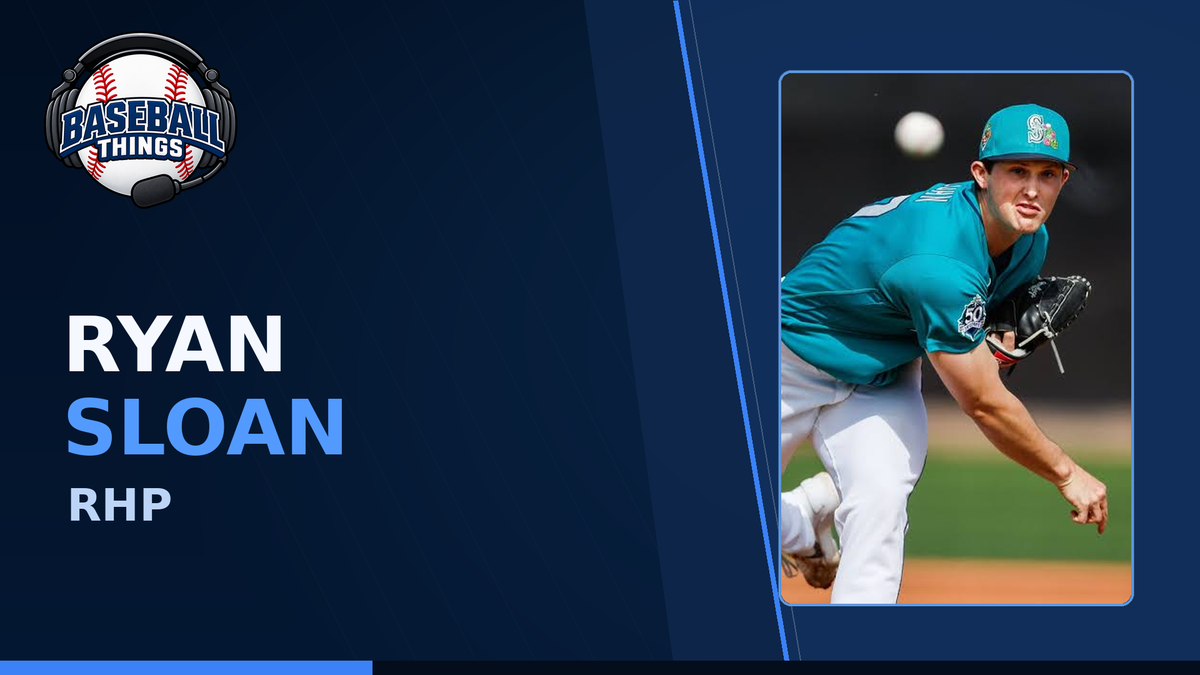
Sloan is on track to earn a trip to the big leagues in 2027, primarily on the strength of a three-pitch mix and plus control. His fastball command improved this season, and we saw the slider and splitter flash. Once we start seeing both of those secondaries spike more often, that's when the call-up train leaves the station. It's an easy No. 3 profile with ace potential.
The control that anchors the profile arrived mid-season rather than year over year. Sloan walked 6.2% of the batters he faced over his first 11 starts of 2026, including a 12.7% rate across a rough April. Over his final 11 starts he walked four men. Total. Eight of those 11 outings were walk-free, a 1.8% rate, and he finished the year at 128 strikeouts against 16 walks.
The stuff climbed with it. His strikeout rate went from 27.0% in 2025 to 30.9% in 2026, 9.9 K/9 to 11.4, and he reached double digits twice after never doing it in 2025 — 11 in six hitless, walkless innings against Texas on May 30, and 11 more in five innings against St. Louis on August 22. Over the closing 11 starts he struck out 32.0% with a 30.1% strikeout-minus-walk rate.
 Jason A. Churchill
The organization treated him accordingly. He was selected to the Futures Game, then held back three weeks afterward and ramped up again rather than dropped straight into the rotation. They also stretched him out for the first time: in 2025 he reached five innings in three of 21 starts and never went further, while in 2026 he did it 10 times in 22 and worked into the sixth. The workload grew from 82 innings to 101.1.
The ERA hides every bit of this, sitting at 3.73 in both seasons. The gap is home runs — five in 2025, 12 in 2026 — and it came while his ground ball rate rose from 50.0% to 55.2%, meaning a larger share of a shrinking fly ball population cleared the fence. xFIP, which normalizes for that, fell from 3.21 to 2.93.
The one number that hasn't followed is hits — 98 in 101.1 innings, 8.7 per nine. It's fair to flag, and fair to discount. Minor league hit totals carry more noise than major league ones, both in the defense playing behind a given staff and in how balls in play get scored, so I'd want another season before calling it a contact problem rather than an environment.